Community & Village Documentation
A community's memory, gathered while its elders can still tell it.
When an elder leaves us, a library closes: the old names of the lanes, the moods of the river, the rules of a festival that no one ever wrote down. A village keeps its memory in its people, and the people are growing older.
Gyaanka Community & Village Documentation preserves collective memory on behalf of a whole community. We gather oral histories, photographs and records before the generation that remembers them is no longer able to share them. Elders, families, artisans, teachers and traders are heard. Places, customs, trades, festivals and journeys of migration are documented, and the result belongs to the community whose story it is.
One community, in the form you prefer
The record can be a published volume, a documentary film, a secure Legacy Archive, or an illustrated Children's Legacy Edition that introduces the village to its youngest members. Verses from Poetic Legacy can mark the day the work is presented.
Who commissions it
Village committees and community associations. Trusts and societies that carry a community's name. Families and donors who have prospered elsewhere and wish to honour the place that raised them. Schools and cultural bodies that wish to record the history of their locality. Groups scattered across the world who want to keep their origins close.
How the documentation is made
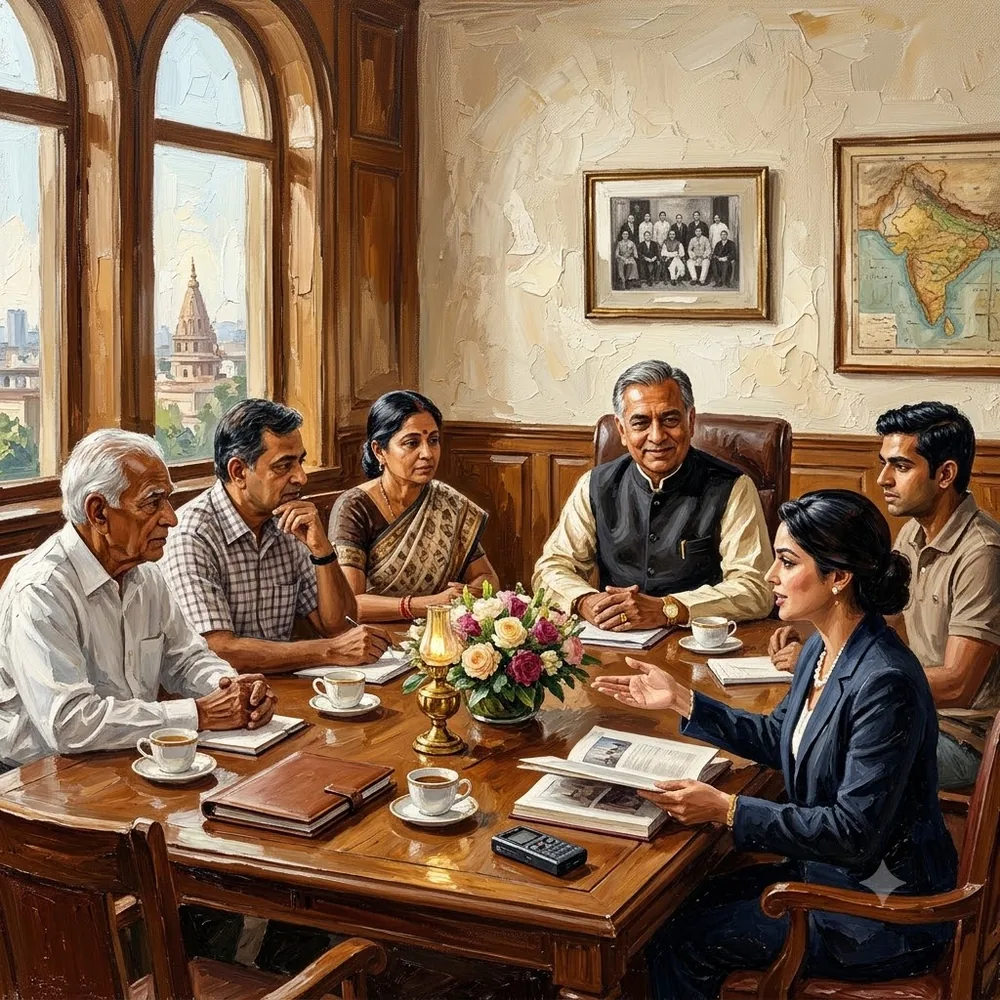
- Gathering. We work with a committee from the community, identify the elders and keepers of memory, and agree how consent will be given.
- Oral histories. Conversations are recorded in homes and public places, in the dialect of those speaking, at a pace that suits them.
- Records. Photographs, registers, letters and papers held by families and institutions are collected, copied with care and returned.
- Review. A review group from the community reads and approves the work. The community decides what is shared and what stays private, and sensitive matters are handled with discretion. Nothing is published without written approval, and all material is kept in strict confidence.
- Production. The volume, film or archive is finished to a high standard, in the form agreed with you at the outset, together with an arrangement for how the community will keep and use it.
See the full process Understand the investment
In your language
Voices are recorded in the language and dialect in which they are spoken, and the record is written in Gujarati, Hindi, Marathi or English. Editions in other languages are written afresh by native authors, never translated word for word, so that members of the community living abroad can read it in the language they use today.
Questions communities ask
Who owns the finished record?
Ownership, use and sharing are agreed in writing at the outset, and the community decides how its record is shared.
Can people who have left the village take part?
Yes. Relatives and former residents in other cities and countries can contribute by video, and their recollections sit beside those of the people who stayed.
What if time is short because the eldest are frail?
We begin with the eldest voices, in shorter sessions, and plan the rest of the work around them. Where a person can no longer speak, relatives and neighbours help to carry their memory.
The first step
We will listen to the story of your community, show you how it could be preserved, and stay beside you at every stage, until you hold a record that its people will be proud to share.